
AI can either make brands feel more personal—or more robotic. The difference is how it’s used.
Companies have spent years building loyalty programs, layering on points, perks, tiers, and discounts. Too often, they come down to a simple trade: I hand you my data, you hand me 10% off. That's not loyalty. It's bribery. And if all a company offers is points for data, it isn't building engagement — it's running a coupon racket.
| New Research from AnswerLab Based on a March 2026 study of 1,500+ U.S. consumers |
|---|
| 24% feel genuinely loyal to most rewards programs they actively use |
| 90% of programs deliver on convenience, value, and ease |
| 61% of members say they actually feel known by the brand |
| 76% of members participate in programs without feeling loyal |
| 21% say their experiences across a brand's channels feel consistently seamless |
| >50% say they do not trust brands to use their data responsibly |
The trap: when rewards stand in for relationships
Almost every brand has a program now, but most people barely notice they're in one. In a recent AnswerLab study of more than 1,500 consumers, only 24% said they feel genuinely loyal to most of the rewards programs they actively use — the rest are enrolled, not committed, often turned off by perk inflation, where everyone is elite, or rewards are too complex to bother. Kohl's Cash is a stark example: massive membership, weak attachment, and a brand that has been losing sales and market share for years. When discounts replace recognition, customers don't get more loyal — they just get more strategic.
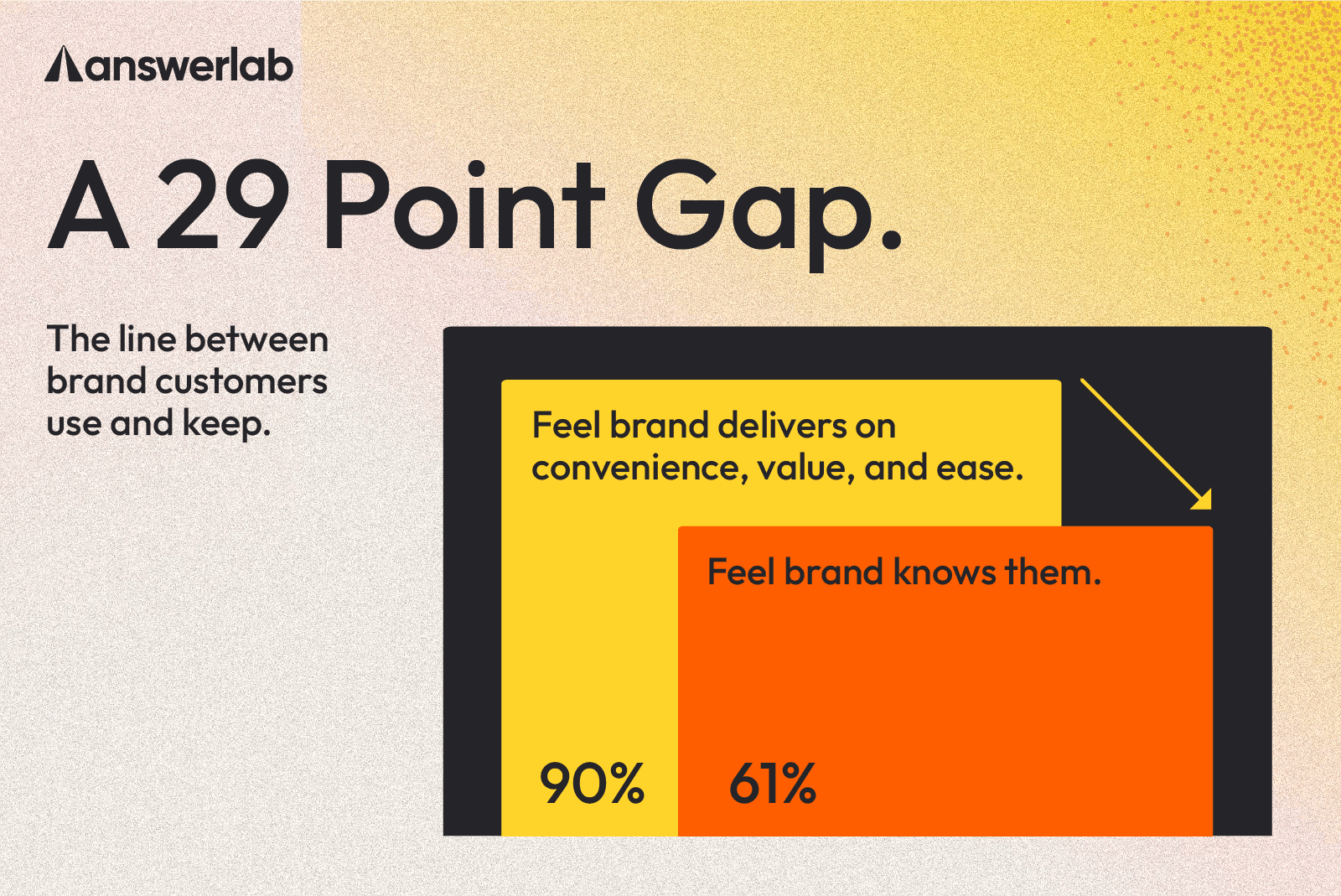
What people actually want is recognition, and the gap is hard to miss: roughly 90% of loyalty programs deliver on convenience, value, and ease — but only 61% of members say they feel known by the brand. That nearly 30-point chasm is where loyalty actually breaks down. Consumers will share data — especially Millennials and Gen Z — but nobody wakes up hoping for more promo codes. They want to be seen, remembered, and treated like they matter.
Loyalty is a two-way street

The single most-repeated phrase across one-on-one interviews conducted as part of our research wasn't about points or apps. It was "two-way street." As one participant put it: "True loyalty with a brand is a two-way street. I'm loyal to them, and they're also loyal to me — not trying to just see me as profit." Another, more bluntly: "Brands expect us to be loyal to them. I can't think of a single brand that actually tries to be loyal to me."
That's the architecture beneath the data. Consumers know they're holding up their end — returning, spending, recommending — and they can tell when brands aren't holding up theirs.
The brands that earn the highest emotional response aren't choosing between a frictionless experience and a human one — they're delivering both. The experience is effortless and the customer feels seen and recognized: a smooth app, a checkout that remembers preferences, a service rep who already has the history. That's the baseline. What separates the brands that earn real loyalty is what they do on top of that — something visible that shows they care. Costco kept prices low through inflation and stuck with its DEI commitments when peers retreated; members read both as proof that the company is loyal back to them. Lululemon's Sweat Collective gives fitness instructors a 25% discount, and the people who qualify don't describe it as a perk — they describe it as recognition: "They give me a 25% discount because they understand what I do." Chewy refunds a no-longer-needed pet food order and lets the customer donate it to a shelter — the kind of unprompted moment our participants reached for as the gold standard of brand behavior. In each case, the program isn't substituting for the relationship — it's the visible proof, on top of an experience that already feels effortless and personal, that the brand is loyal back.
Take travel. I'm a frequent flier devoted to Delta, partly for the Diamond status, but more because the recognition is in the details: thanked by name at boarding, agents who already know my history when a flight goes sideways, problems solved fast enough that I leave feeling seen. That kind of moment creates more loyalty than another 5,000 bonus miles. United, meanwhile, loses customers when indifferent service outweighs any perks.
Table 1: How Chewy Built Loyalty Through an Unprompted Moment
| Industry | Pet retail |
| The behavior | Refunds a no-longer-needed pet food order and lets the customer donate the food to an animal shelter |
| Why it works | The brand acts loyally to the customer without being asked, and turns a potential negative moment into one of generosity |
| Why customers cited it | AnswerLab interview participants reached for it as the gold standard of brand behavior |
Table 2: Lululemon Sweat Collective: When a Discount Is Read as Recognition
| Industry | Apparel |
| The program | A 25% discount available to certified fitness instructors |
| Why it works | Members do not describe it as a perk. They describe it as recognition: "They give me a 25% discount because they understand what I do." |
| The insight | The same discount, framed as recognition of identity rather than price reduction, produces emotional loyalty rather than transactional behavior |
Table 3: Costco: Loyalty Through Visible Commitments
| Industry | Retail / membership warehouse |
| The behaviors | Kept prices low through inflation; stuck with DEI commitments when peers retreated |
| Why it works | Members read both as proof that the company is loyal back to them |
| The insight | Brand actions outside the program itself can drive program loyalty more than the program structure |
Where AI fits — and where it fails
AI is often pitched as the engine that will finally crack personalization. But personalization alone isn't the goal — and customers can tell the difference between being targeted and being understood. What earns loyalty in an AI world is experience that feels aware: intuitive, intentional, and tuned to the moment a customer is actually in.
Done poorly, AI just sharpens the same transactional playbook: better-timed discounts, more aggressive nudges, predictive models that treat customers as revenue opportunities. That erodes trust — and trust is already thin: more than half of consumers say they do not trust brands to use their data responsibly. People can feel when they're being optimized rather than served.
Done well, AI makes the brand feel like it's paying attention. It removes repetitive friction — the clipboard at the doctor's office, the account number recited for the third time. It anticipates needs without crossing into intrusion. And it moves a customer from a chatbot to a person without losing the thread — because today, only 21% of consumers say their experiences across a brand's channels feel consistently seamless, and every reset is a daily reminder that the brand isn't actually paying attention. Solve those handoffs, and AI does what it's supposed to: not sharper selling, but the brand showing up the way a person would — aware, intentional, and on the customer's side.
Three things brands should do now
Loyalty doesn't sit with one team anymore. The experience earns it, not the program — and the experience is built across product, design, service, and data. Whoever has the program in their P&L, the work below requires the silos to come down.

1. Step 1. Ask the uncomfortable question. If you removed every discount tomorrow, would your program still matter to customers? If the answer is no, you're in the transactional trap. Audit what actually drives repeat business — and whether your rewards reflect how customers actually live, or just how finance wants them to spend.

1. Step 2. Fix one broken handoff — and put it on the roadmap. The seams between app, web, store, and human aren't service problems. They're product decisions. Pick the moment your operation breaks down most often — the lost context when someone calls back, the agent who starts from zero after ten years as a customer — and treat it as a P0, not a backlog item. One consistently smooth experience customers notice will move loyalty metrics more than the next three features will.

1. Step 3. Measure what matters, not what's easy. Most programs track enrollment, points issued, and redemption rates. Those are finance metrics, not loyalty metrics — and they obscure the inverse signal: 76% of members participate without feeling loyal. Start tracking retention by cohort, share of wallet, and qualitative feedback on whether customers feel recognized. If you can't measure whether they feel valued, you're flying blind.
In the end, rewards are the cherry on top. Experience is the foundation. If your loyalty roadmap doesn't make customers' lives meaningfully easier, more personal, or more human, it isn't a loyalty strategy — it's a pricing tactic. Get that wrong, and those "loyal" customers were never yours. They were just waiting for the next coupon.
Q&As
Why do customers participate in loyalty programs without feeling loyal to the brand?
Because most programs are built around transactions, not recognition. In a March 2026 AnswerLab study of 1,500+ U.S. consumers, 76% said they participate in loyalty programs without feeling loyal to the brand. 90% of programs deliver on convenience, value, and ease, but only 61% of members say they feel known by the brand. That 29-point gap is where loyalty actually breaks down. Customers will share data, especially Millennials and Gen Z, but nobody wakes up hoping for more promo codes. They want to be seen, remembered, and treated like they matter.
How can brands use AI in loyalty programs without losing customer trust?
By using AI to make brands feel more aware, not more aggressive. More than half of consumers do not trust brands to use their data responsibly, so personalization done poorly accelerates trust erosion rather than loyalty. AI works when it removes repetitive friction (the clipboard at the doctor's office, the account number recited for the third time), anticipates needs without crossing into intrusion, and moves customers from chatbot to human without losing the thread. Only 21% of consumers say their experiences across a brand's channels feel consistently seamless. Solving those handoffs is where AI earns trust, not by sharper selling.
What metrics should CMOs use to measure whether a loyalty program is actually working?
Three categories of metrics matter most, and most programs only track the first. Enrollment, points issued, and redemption rates are finance metrics, not loyalty metrics. They tell a CMO whether the program exists, not whether it works. The metrics that actually indicate loyalty health are retention by cohort, share of wallet over time, and qualitative feedback on whether customers feel recognized. If a CMO cannot measure whether customers feel valued, they are flying blind on the only thing the program is supposed to produce.
What does a two-way loyalty relationship between a brand and its customers look like?
It looks like a brand holding up its end of the bargain. Customers know they're returning, spending, and recommending, and they can tell when brands aren't reciprocating. AnswerLab's research found that "two-way street" was the single most-repeated phrase across one-on-one consumer interviews. The brands that earn the highest emotional response are not choosing between a frictionless experience and a human one. They are delivering both, with something visible on top that shows they care: Costco keeping prices low and standing by its DEI commitments, Lululemon's Sweat Collective recognizing instructors for what they do, Chewy refunding pet food and offering to donate it to a shelter.
To learn how AnswerLab can help you to build a differentiating loyalty program, speak to one of our research and experience consultants.