
Customers don't have to choose your brand anymore. In an AI-driven world, AI will choose for them—unless you've built an experience it can't replace.
Walk into most boardrooms right now and you’ll hear the same idea: in an AI-driven world, experience matters less. Smarter systems will deliver. Faster answers will satisfy. Automation will replace the need for thoughtfully designed interactions.
It’s a compelling idea. It’s also wrong.
For as long as people have been buying and choosing, experience has shaped who they pick, and who they pick again. The businesses customers feel closest to aren’t the biggest or the most optimized. They’re the ones that feel familiar–the ones that recognize them, remember their order, their history.
In AnswerLab’s recent study of 1,500 consumers*, when people described the brands they feel most connected to, they didn’t talk about features or pricing. They talked about the coffee shop that knows their order. The place where the interaction feels easy, personal, unmistakably human.
That pattern has held for hundreds of years. People return to experiences that feel simpler, more intuitive, more personal.
The real question isn’t whether AI will change experience. It will. The question is:
Why would the thing that has shaped customer choice for hundreds of years suddenly stop mattering now?
The race isn’t for share of wallet. It’s for share of mind.
In an age of AI, the brands that win are the ones customers go to first—and don’t want to replace.
That kind of preference is built through experience, through interactions that feel innately human, instinctive to the person, tuned to the moment.
That’s where the gap is widening.
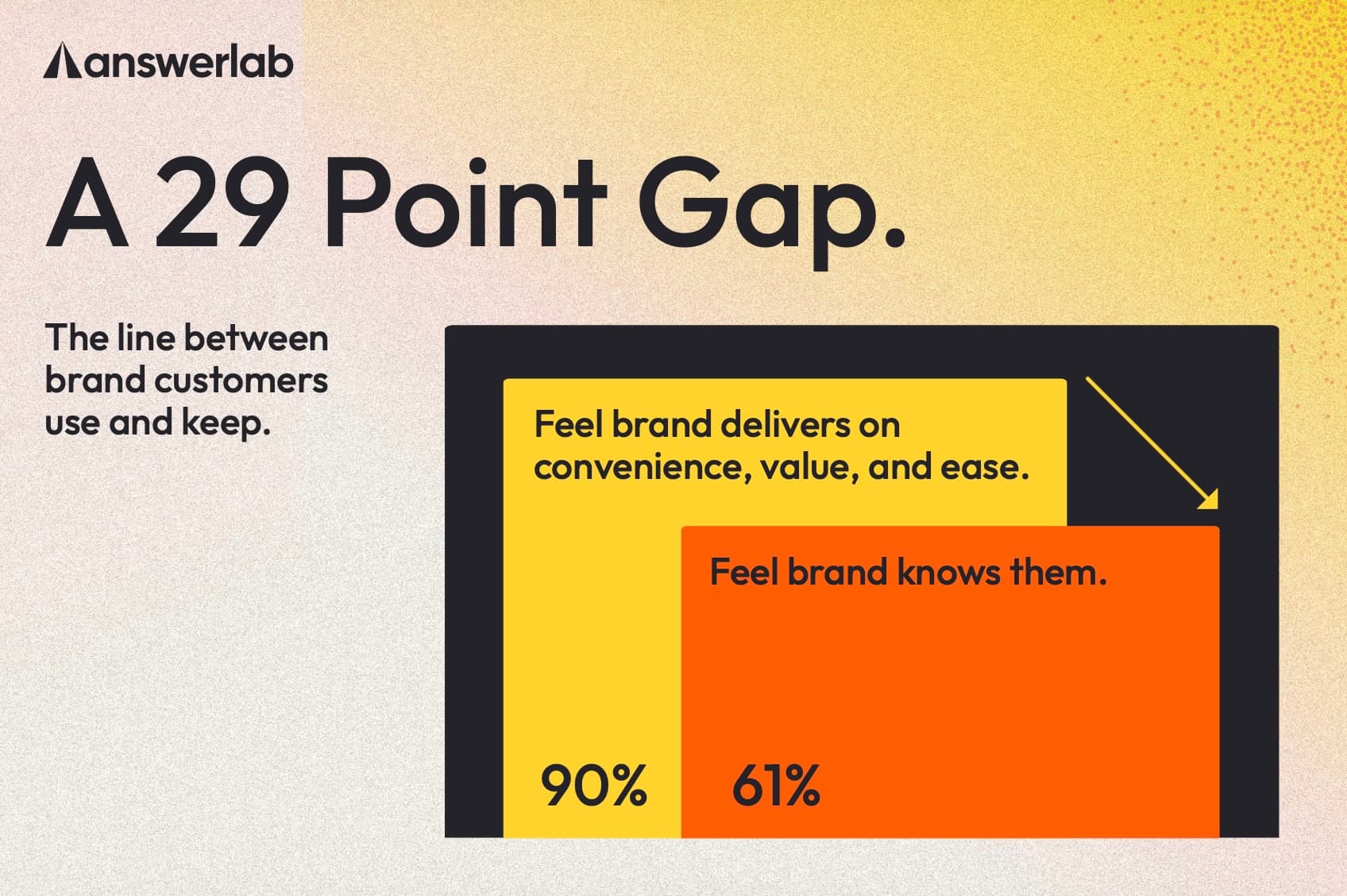
90% of customers say their favorite brand delivers on convenience, value, and ease. Only 61% feel known by it. That 29-point gap isn’t a soft metric. It’s the line between a brand customers use and a brand customers keep.
Gen Z, the customers shaping future expectations, places even greater weight on being known. More likely to notice when it’s missing. Less likely to tolerate it when it is.
AI should raise the baseline for what “good” looks like. Better experiences become easier to find, compare, and switch to. The brands that stand out won’t be the ones that work. They’ll be the ones that make us feel known.
What was once a differentiator—recognition, continuity, relevance—is becoming the price of entry.
The brands that fail won’t just fall behind. They’ll be the ones customers stop thinking about—and the ones AI doesn’t surface at all.
The bar you’re clearing is no longer the bar that matters.
Most companies are still optimizing for the bar they were built to clear: convenience, value, ease. The bar has moved. AI moved it.
34% of customers say their expectations of brands are higher than ever before, and every AI-powered interaction that facilitates a sense of connection somewhere else recalibrates what they expect from you. A system that remembers context. Anticipates intent. Adapts in real time. Each one moves the floor under your feet.
Connection no longer comes from performance alone. In an AI world, the bar isn’t just personalized. It’s tuned in. Aware. Continuous.
That’s the shift. Experience isn't about delivering efficiently, it's about intimacy at scale. The opportunity isn’t to collect more data; it’s to use what you have to make customers feel known.
Because here’s the part most leaders miss: the customers you fail aren’t all going to a competitor. They’re going to AI. And AI won’t bring them back to you unless you’ve given it a reason to.
Customers don’t experience channels. They experience whether it all works together.
Internally, companies still operate in parts—marketing defines the promise, product builds it, service cleans up the breakage. Customers don't experience those divisions. They experience one thing: whether it all holds together when they cross from one channel to another.
They feel it when it doesn't. When they have to repeat themselves. When the system resets at the worst possible moment.
Only 21% of customers say experiences are consistently seamless, and when they break, 49% reduce or stop engaging altogether.
In an AI-driven world, the seams aren't just frustrating. They're disqualifying. AI doesn't unify your organization—it reflects it. Every disconnect, every reset, every repeat-yourself moment becomes a signal AI uses to surface someone else.
When the experience doesn't carry forward, the relationship doesn't either.
The hidden risk: comfort is more fragile than it looks.
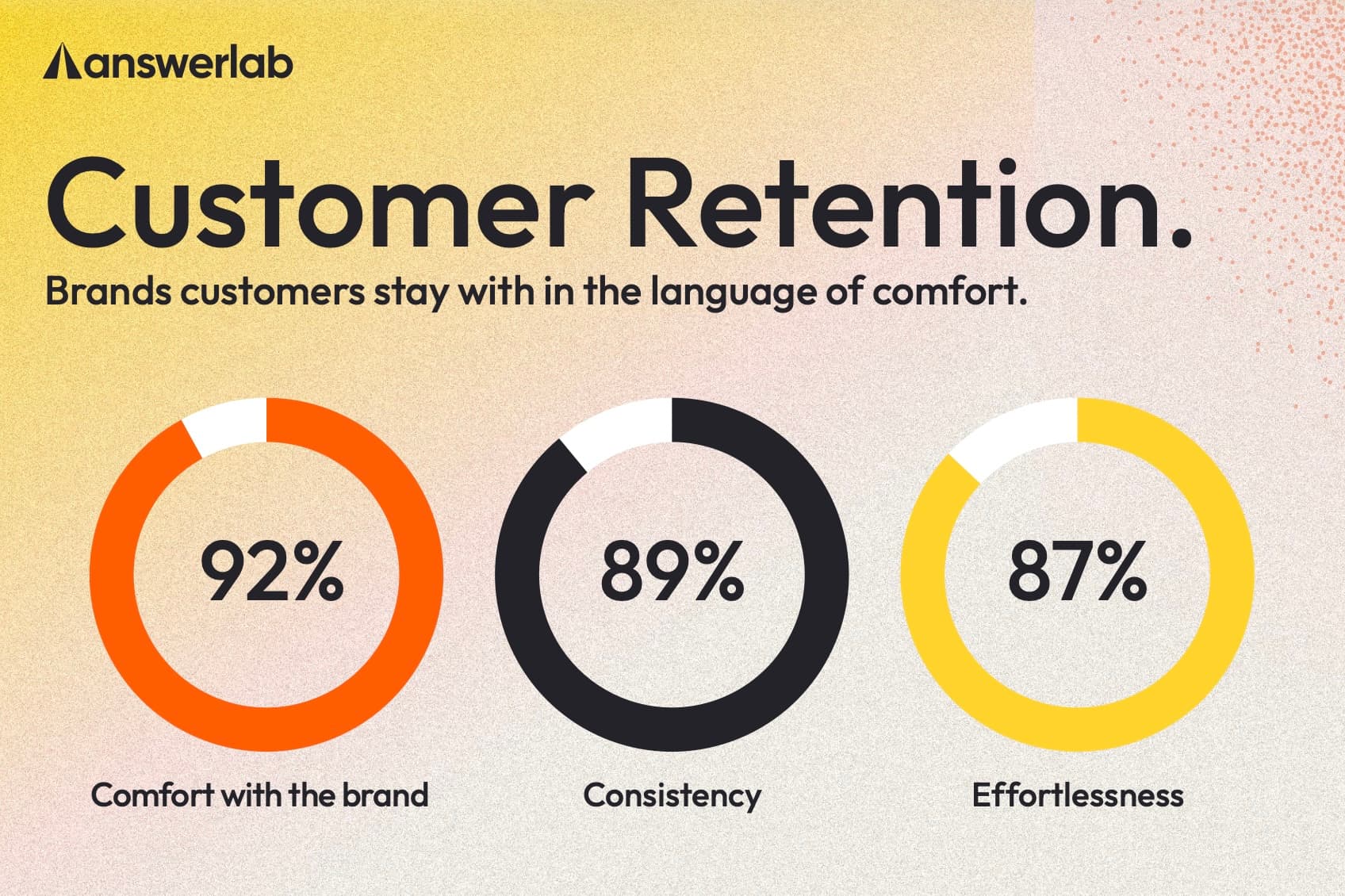
Customers describe the brands they've stayed with in the language of comfort. Comfort with the brand (92%). Consistency (89%). Effortlessness (87%).
That isn't loyalty. It isn't love. It's habit—dressed up to look like commitment.
That comfort historically created resilience because switching took effort. AI removes the effort.
If a customer turns to an AI assistant and you're not top of mind, you've lost them. They may feel comfortable with that system—not with you. And unless your brand has given that system a reason to choose you, it won't.
Which means comfort, once tied to your brand, can be displaced.
Quietly. Quickly. And at scale.
Experience is no longer just a differentiator. It’s the only thing holding your customers in place.
The companies that win in an AI world won't be the ones that simply deploy more AI. They'll be the ones whose experiences feel innately human—where every interaction carries the instinct of someone who actually knows you, anticipates what you need, and treats you like a person, not a profile.
That's not a brand promise. It's a roadmap criterion.

It means:
- Validating moments, not features.
- Building the connective tissue between teams—not just inside them.
- Using AI to extend what already feels human, not to replace what doesn't.
Because when leaving is effortless, staying has to be earned. The customer who used to forgive a bad app update will now ask their AI for an alternative before you get a chance to recover.
Customers have never wanted to experience your org chart. In an AI-driven world, they don't have to experience your brand either—unless you give them an experience they can't replace.
*Based on a study of 1,500 U.S. consumers conducted by AnswerLab in March, 2026.
Frequently Asked Questions About Customer Experience in an AI Era
Why is customer comfort with a brand more fragile than it looks?
Because most of what brands read as loyalty is actually comfort dressed up to look like commitment. In a March 2026 AnswerLab study of 1,500 consumers, the language customers use to describe brands they've stayed with is the language of habit, not the language of devotion: 92% describe comfort, 89% describe consistency, 87% describe effortlessness. That kind of comfort historically created resilience because switching took effort. AI removes the effort. If a customer turns to an AI assistant and the brand is not top of mind, the customer is already gone. The comfort, once tied to your brand, can be displaced quietly, quickly, and at scale.
Why do customers stop engaging when their experience across a brand's channels feels disconnected?
Because internally, companies still operate in parts (marketing defines the promise, product builds it, service cleans up the breakage), but customers don't experience those divisions. They experience one thing: whether it all holds together when they move from one channel to another. AnswerLab research shows only 21% of customers say experiences across a brand's channels feel consistently seamless. When experiences break, 49% reduce or stop engaging altogether. In an AI-driven world, the seams aren't just frustrating. They're disqualifying. AI doesn't unify your organization. It reflects it. Every disconnect, every reset, every repeat-yourself moment becomes a signal AI uses to surface someone else.
How should brands build experiences that AI assistants will recommend?
By making the brand worth recommending in the first place, then making the experience legible to the systems doing the recommending. Most content on this topic focuses on the technical layer: schema markup, structured data, generative engine optimization. Those matter, but they are the floor, not the ceiling. The brands AI assistants will surface most consistently are the ones with recognisable, distinctive experiences that already earn human preference. AI compresses the choice set. If a brand isn't already top of mind for the customer, and isn't legible to the system, it won't be in the shortlist of three options the assistant presents.
What should CMOs prioritise when AI is choosing brands for customers?
Three priorities, in order. First, win share of mind, not just share of wallet. AI compresses the consideration set, which means brands that aren't already recognised won't be recommended. Second, close the recognition gap. AnswerLab research shows 90% of brands deliver on convenience but only 61% deliver on recognition. The 29-point gap is where loyalty actually breaks down, and in an AI-mediated world, where switching is effortless, the gap becomes the difference between staying and being replaced. Third, build experiences AI can extend, not patch. AI doesn't fix disconnected experiences. It reflects them. Investing in cross-functional experience design is the prerequisite for AI to add value.
To learn how AnswerLab can help you to build a differentiating experience strategy, speak to one of our research and experience consultants.