
AnswerLab's March 2026 consumer loyalty study examined what drives — and erodes — brand loyalty, drawing on a nationally representative survey of 1,500 U.S. consumers and 50 AI-moderated qualitative interviews with active loyalty program members.
The findings reveal a consistent pattern: most brands have mastered functional delivery but fall short in emotional connection. The gap between the two is where loyalty is won or lost.
The Recognition Gap
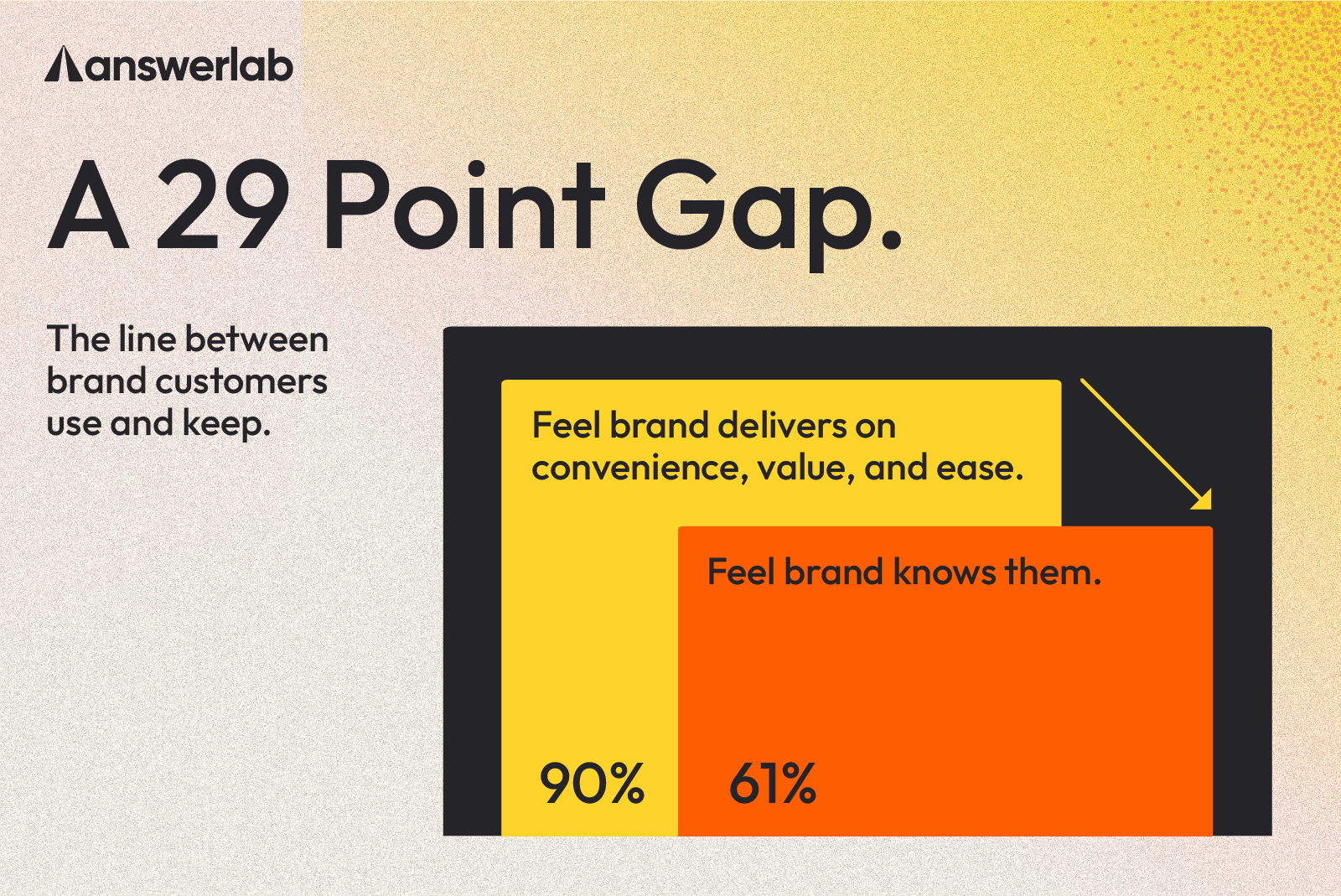
90% of consumers say their favorite brand delivers on convenience, value, and ease. Only 61% say that brands makes them feel genuinely known.
That 29-point Recognition Gap is the study's central finding. It separates brands consumers use from brands consumers love — and it points to where most loyalty strategies are currently falling short.
Functional delivery has become table stakes. The brands with the most emotionally committed customers in this study — including small and local businesses as well as larger brands like Costco and Chewy — were not distinguished by their programs or their technology. They were distinguished by making customers feel recognized, often through specific human moments that stayed with people long after the fact.
Algorithmic recognition (personalized recommendations, purchase history-based offers) was broadly appreciated but rarely produced emotional intensity. Human recognition — a staff member who remembers you, a brand that responds to a specific moment in your life — was rare and generated the highest-intensity responses in our study.
"I had one time where I didn't need an order anymore, and instead of making me send it back, [Chewy] refunded me and let me give it to a local shelter. It made me feel like they cared."
A Loyalty Program Doesn't Equate to Brand Loyalty
Only 24% of consumers feel loyal to almost all or all of the loyalty programs they currently participate in.
This finding points to a distinction the research explored in depth: loyalty programs are effective at shaping behavior. They redirect where people shop, what they order, and how often they come back. But behavioral participation is not the same as emotional commitment—and the two are not reliably correlated as program metrics tend to assume.
When asked to describe loyalty in their own words, consumers across the qualitative sample defined it as a choice made under pressure: choosing a brand when alternatives exist. By that definition, most programs are not producing loyalty. They are producing compliance.
"Brand loyalty is something that I don't think companies revere enough. They expect us to be loyal to them — I can't think of a single brand that tries to be loyal to me."
The brands that generated the most durable loyalty in our study either had no traditional program or had one so embedded in a larger value proposition that the program itself was inseparable from the brand experience.
Cross-Channel Consistency is a Matter of Trust
Consumers increasingly expect brands to carry context forward across interactions — to know who they are, whether they're on an app, a website, or talking to someone in person.
Our data shows most brands are not meeting that expectation:
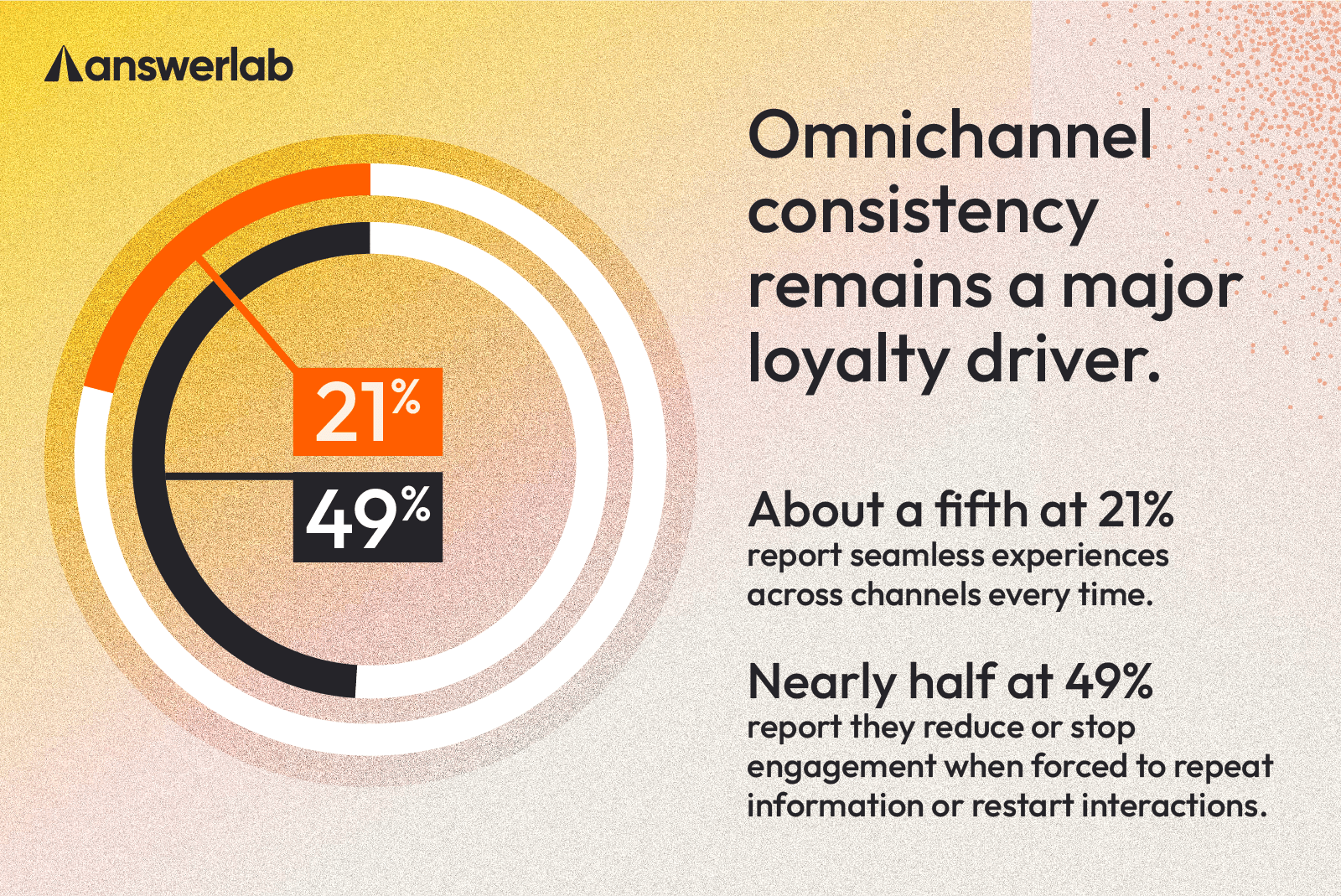
- Only 21% of consumers say their cross-channel experiences feel seamless every time
- When consumers have to repeat information across channels, 49% reduce or stop their engagement with that brand altogether
Our qualitative data adds texture here. Participants described being forgotten by a brand they had consistently patronized as a trust-breaking event—not a minor inconvenience. The phrase used over and over again: it felt like starting over.
"A truly seamless experience would look like … they hand me off and say, oh, hello sir — I've got your file right in front of me."
Continuity across channels is not just a UX problem. It is a loyalty problem.
Gen Z: High Need, Low Expectation
Gen Z showed the strongest stated need for emotional recognition from brands — and the lowest expectation of receiving it.
Specifically, Gen Z respondents were less likely than other generations to agree that even their most-aligned brand treats them like an individual, and more likely to say that programs rarely make them feel appreciated.
Many have simply lowered their expectations. Our qualitative data showed this pattern across age groups, but it was most pronounced among younger consumers: not frustration, just a settled assumption that brands won't get this right.
That creates a first-mover opportunity. The brand that delivers genuine recognition at scale — not algorithmic targeting, but the experience of being known — will be capturing loyalty from a generation currently in a holding pattern of conditional habit.
Trust is the Defining Factor for Personalization that Feels Personal
Brands often assume consumers want more personalization. Our data complicates that assumption.
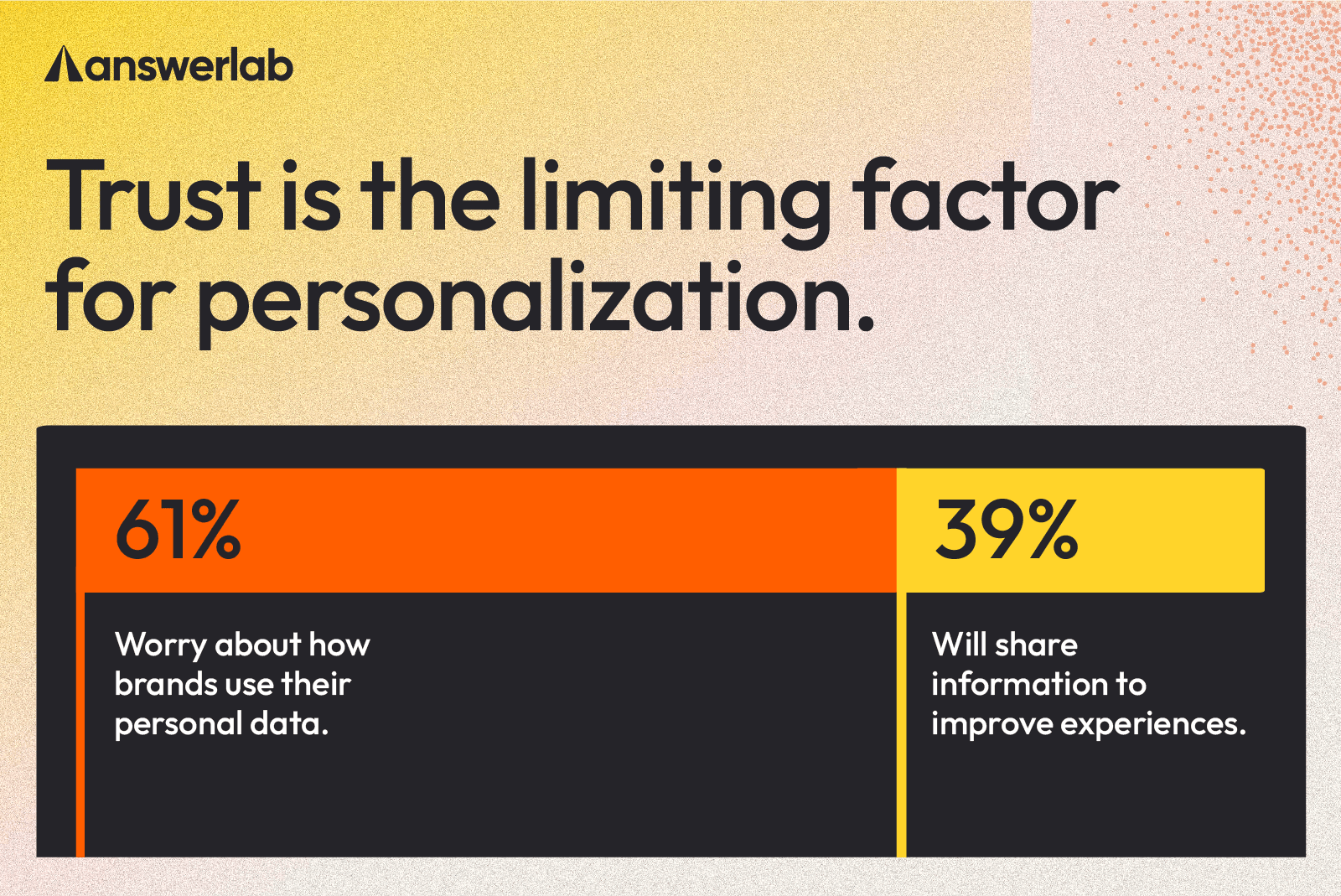
- 61% of consumers worry about how brands use their personal data
- Only 39% would share more information in exchange for a better, more personalized experience
The qualitative interviews surfaced a consistent distinction: personalization that feels like service (a brand using what it knows to make your experience easier) is welcome. Personalization that feels like surveillance (a brand demonstrating it knows things you didn't consciously share) produces discomfort and erodes trust.
"When it works, it feels like convenience that feels like a gift. When it goes wrong, it feels really exploitative."
The line between the service and surveillance is not about the data itself — it's about whether the use of that data is understood and feels like it benefits the customer.
What this Means for Brand and Experience Leaders
Five consequential takeaways, including:
- Loyalty programs and brand loyalty are not the same thing. Programs can be effective behavioral infrastructure. But they are not, on their own, relationship builders.
- The recognition gap will not close through better algorithms. Algorithmic personalization is table stakes. Human recognition — at scale — is the differentiator.
- Reciprocity is not optional. Consumers have a precise internal accounting of what they give brands and what they get back. Programs that extract behavior without demonstrating brand investment register as extractive, not generous.
- Gen Z loyalty is up for grabs. They are the quickest to disengage, but the most vocal when a brand genuinely earns their loyalty. The opportunity is large precisely because expectations are so low.
- Most programs are measuring the wrong thing. Frequency, redemption, and NPS measure compliance and satisfaction. None of these metrics measures whether a consumer would choose this brand if a comparable competitor made a better offer tomorrow. Adding commitment-under-pressure metrics to your CX stack will reveal your at-risk segment before it shows up as attrition.
Frequently Asked Questions
What was the goal of the study?
To understand what brand loyalty actually means to consumers, not as a program feature, but as an emotional and behavioral relationship. Most loyalty research focuses on program mechanics and enrollment. We wanted to go deeper: why do consumers connect with brands at all, and what does it take to keep them?
What creates customer loyalty in 2026?
AnswerLab's research suggests that loyalty is increasingly driven by recognition, trust, continuity, and emotional relevance rather than rewards, discounts, or points alone.
What is the Recognition Gap?
It's the 29-point difference between the 90% of consumers who say their favorite brand delivers on convenience, value, and ease — and the 61% who say that brand makes them feel genuinely known. It's the gap between the brands consumers use and the brands consumers stick with.
Do loyalty programs actually build loyalty?
They build behavior. Programs are effective at redirecting where people shop and how often they return. But only 24% of consumers feel loyal to almost all or all of the programs they participate in. Enrollment is not the same as emotional commitment.
Why does "seamless" actually mean to consumers?
Not a technically perfect omnichannel experience — something more basic than that. Consumers expect a brand to know who they are in every interaction. When they have to start from scratch or repeat themselves, it registers as a trust-breaking event, not a minor inconvenience.
Why is Gen Z a particular opportunity?
They have the highest stated need for emotional recognition of any generation in our study, and the lowest expectation of receiving it from major brands. That gap represents an unclaimed first-mover advantage — the brand that closes it will be capturing a generation that converts loyalty into social amplification at a higher rate than any other group.
What's the difference between personalization that works and personalization that doesn't?
More data may not help as much as brands assume. 60% of consumers already believe brands are personalizing their experience. The perception of personalization is not the gap. The gap is trust: only 48% trust brands to use their data responsibly, and only 41% actually like personalization when they encounter it. The problem isn't capability, it's credibility.
Based on a nationally representative survey of 1,500 U.S. consumers and 50 AI-moderated qualitative interviews, conducted by AnswerLab in March 2026. Study authored by Leah Namdar-Cohen, Experience Strategy.